- Home
- Maine Coon Kittens
- Kitten Proofing Your Home
Kitten Proofing a Home Before the Big Arrival
•
Kitten proofing the home isn't usually the first thing we think about before getting a new addition, but we should!
Because Maine Coon kittens tend to be more athletic, larger than average, and highly intelligent, safety at home is crucial.
It's surprising how many potential hazards an average home contains.
When our kittens were young, Alice would hide behind the kitchen cabinet doors. She was quite the little explorer.
We almost squished her behind the trash a few times. Thinking about Maine Coon kitten proofing brings back memories!
If you ever can't find your kitten, try dresser drawers, low cupboards, and other hiding places your new furry family member may have discovered during their explorations.
Top 10 Hazards to Fix First:
If you only have 10 minutes today, fix these first:
- Loose cords and strings
- Recliners and sofa beds
- Open toilets and buckets
- Stoves and hot appliances
- Washers, dryers, and dishwashers
- Toxic plants
- Medications left out
- Small chewable items
- Uncovered trash cans
- Doors and windows that don't latch properly
If you can't get enough of Maine Coons, you'll love our fun, free Daily Digest!

Start Here: The 10-Minute Safety Sweep
Even experienced cat owners miss things. Homes change, plants get purchased, gifted or moved. Furniture gets rearranged, and cats notice everything.
If you only have ten minutes today, this is the sweep that catches the most common, and most easily overlooked, risks.
Start at eye level, then go lower.
1. Look for chewable cords and strings
Phone chargers, lamp cords, blind pulls, hoodie strings, and ribbon-like décor are still one of the biggest risks. If it dangles or coils, assume it's interesting.
Quick fix: gather loose cords together, shorten blind pulls, and remove anything string-like that can’t be supervised.
2. Check reclining furniture and sofa beds
Recliners, adjustable beds, and pull-out sofas have pinch points that kittens can slip into silently.
Quick fix: block access underneath, or get in the habit of checking before sitting or closing anything mechanical.
3. Scan for toxic plants, especially the "surprise" ones
Many homes already have plants that aren't obvious hazards until you look them up. A few of the worst offenders that commonly catch people off guard:
- lilies (even pollen or water from the vase)
- pothos and philodendron
- sago palm
- aloe vera
Quick fix: move them out of reach today, then decide later whether they stay in the house at all.
4. Do a kitchen and bathroom counter sweep
Anything small enough to bat, chew, or swallow is fair game: pills, vitamins, hair ties, dental floss, cotton swabs.
Quick fix: clear counters completely, even if it feels excessive at first.
5. Close lids, doors, and appliances
Open toilets, buckets, washing machines, dryers, dishwashers, and ovens all attract curious kittens, especially when warm.
Quick fix: lids down, doors closed, and a quick visual check before starting any appliance.
6. Take one focused look at the floor
Dropped rubber bands, twist ties, bits of plastic, and children's toys often blend into the background.
Quick fix: one deliberate examination beats hours of kitten-proofing later.
If this sweep makes you think, "Oh… I didn't realize that mattered," you're doing it right.
Once you've checked these areas, you've already covered the most common in-home risks.
Set Up a Safe Space/Room
Before worrying about the whole house, it helps to start with one room that's truly kitten-ready before bringing your new fur-friend home. This doesn't have to be fancy or permanent.
It just needs to be a space where you know your kitten can explore without getting into trouble.
A spare bedroom, office, or quiet corner room usually works best. Somewhere with a door you can close, and without a lot of foot traffic at first.
Kittens do better when they aren't overwhelmed, and this gives them a place to settle in while they get used to new sounds, smells, and routines.
Inside the space, keep things simple. Food and water, a litter box placed a bit away from them, a soft place to sleep, and a few toys are plenty.
You don't need to fill the room. In fact, fewer objects make it easier to notice what your kitten is interested in, and what might need adjusting later.
Just as important is what doesn't belong in the room. Extra cords, clutter, open storage bins, and anything that invites hiding in tight spots are better left out.
If something can be tipped over, crawled behind, or pulled down, assume it will be tested.
This kind of setup prevents most early accidents simply by limiting opportunity.
Once your kitty is comfortable here, expanding their access to the rest of the house becomes much easier, and far less stressful for everyone.
Room-by-Room Safety Checks
Living areas and furniture
This is where kittens spend most of their time, and where habits form quickly. Look at the space the way a kitten would: low, curious, and persistent.
Areas behind furniture, under couches, and inside anything that moves or folds are often discovered long before we think to check them.
Kitchen and heat sources
Kitchens combine warmth, smells, and activity, which makes them especially interesting. Even when a kitten isn't underfoot, counters, open doors, and cooling appliances can invite exploration.
It's less about locking everything down and more about being consistent with what stays open and what doesn't.
Bathrooms and water risks
The Maine Coon breed is often fascinated by water. Bathrooms tend to be small, quiet, and full of textures and sounds kittens aren't used to.
They're also spaces we open and close frequently without thinking about who might slip in behind us. A quick check before leaving the room is best.
Laundry rooms and appliances
These spaces often get less attention, especially if they're used daily. Warmth, enclosed spaces, and lingering smells make them appealing resting spots.
Developing the habit of checking before starting anything mechanical goes a long way here.
Plants, medications, and household chemicals
This category changes the most over time.
New plants come home, items get set down temporarily, and routines shift - including things that fall into the category of toxic plants and household substances.
It’s worth revisiting these areas occasionally, especially if something new has entered the house.
For readers who like to double-check everything in one place, the original safety checklist is included below for reference.
The following Maine Coon kitten safety checklist is from Carla Maria Sullwold of Mannahatta Maine Coons. It covers many potential dangers.
Kitten Proofing Your Home - Checklist
- If you must permit smoking in your home, do so AWAY FROM THE CAT--outdoors, preferably or in a room apart. Ventilate afterwards. Studies show secondary smoke significantly shortens the cat's lifespan; when your cat is with you in a a closed car, DO NOT SMOKE.
- Electrical cords and phone cords should not be left dangling and should, as far as possible, be tucked neatly out of sight.
- Electrical outlets that are not in use should be covered with baby-proof plastic covers.
- Never walk away and leave an electrical appliance plugged in and on; chewing through the wires of a hot iron, for example, can be fatal.
- Never leave the kitten/cat in the kitchen with the gas turned on; Maine Coon kittens, like babies, do not know that the stove is hot or the flame is dangerous.
- Be careful to store sharp knives and kitchen implements after use.
- Always close the toilet seat and toilet lid; a kitten can drown.
- Never use toilet bowl deodorizers; should the kitten/cat drink the water, he/she will be poisoned.
- Always make certain fire-screens are firmly shut. Never leave windows without screens open and make sure the screens you do have are tightly closed and of a secure weight.
- Be very careful of reclining chairs and sofa beds; always check that the kitten or cat has not crawled up in a pillow or underneath, as he/she can be crushed as you open or close the mechanism.
- Always check the refrigerator, dishwasher, washer, clothes dryer, washing machine and oven before turning on; Maine Coon kittens especially may crawl into to these enclosed spaces.
- Check closets to make sure kitten/cat has not gotten locked in without food or water.
- Be careful when closing doors so as not to catch your cat's tail or paws and cause him permanent harm.
- Keep the garbage cans off limits so the kitten/cat does not forage for a forbidden item.
- Be careful of dangling drapery and venetian blind cords, as children and cats can strangle.
- Always store cleaning supplies, chemicals, toilet cleaners, insect repellent, and medicines in non-openable, out-of-reach containers and cabinets.
- Be very careful about any pills or medications you take; one aspirin, for example, can kill a cat!
- Keep the following out of kitten’s reach: needles, thread and sewing supplies; rubber bands; plastic wrap; styrofoam; cellophane; cigarettes, yarn toys; toys with easily removable parts; paint and paint removers; ant poison; anti-freeze, ice melt; automotive supplies and fluids. Store plastic bags out of reach of your kitten.
- Be very careful what cleaning solutions you use on your floors, carpets, and upholstery; for the environment as well as for your cat's safety, it is best to use natural, non-toxic products only.
- Keep out of reach all poisonous substances and hazardous chemicals.
- Keep out of reach all poisonous plants; be careful that the kitten/cat does not drink any spilled water from these plants.
- Be attentive to temperature at home: avoid heatstroke by using air-conditioning, fans, or screened windows ajar; Maine Coons like it colder rather than warmer, and this is better for their coats, but needless, to say, the extremes of cold are as dangerous as the extremes of heat, both at home and in the car.
- Never leave a cat in a closed automobile with the windows shut; heatstroke is swift and fatal; in fact, do not leave the cat alone in a car at all!
- For auto travel use a hard-sided carrier and, if possible, secure it to the back seat with the seat belt through the handle.
- If the need arises to use an exterminator for insect or rodent pests, be certain that you discuss the chemicals to be used and when it will be safe for your cat to return to the treated areas; if using pest prevention on your own try for the natural products; be very careful of mouse traps as they can seriously injure your cat as well.
- Be attentive to your cats interaction with dangerous insects; bee stings can be fatal; poisonous spiders and other insects are a hazard, as are insects or rodents which have ingested chemicals to kill them; mosquitoes carry heartworm, so, again, screens are essential for the home and avoidance of the outdoors in mosquito season
- Fleas and Ticks are becoming a hazard even in urban areas, so please use flea protection from April to October. Consult your vet; we like topicals like Advantage, Frontline or Bio Spot.
Downloadable, printable PDF version:
Free Download: Kitten Proofing Your Home
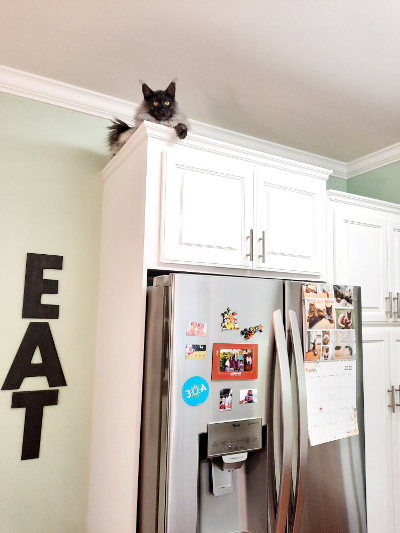
The good news is that just like babies, kittens do grow up and grow out of the desire to get into everything.
Although you'll always have a certain level of caution around the house - like when closing the dryer door or hanging Christmas lights,
Kitten proofing your home is a huge part of pet care! This super helpful list was shared by Carla Maria Sullwold of Mannahatta Maine Coons. Thank You!
Ready to keep going?
« Explore more about Maine Coon kittens, from the first days at home to growing up.

Love this site?
You’ll love our magazine too.
Hi, I'm Carrie! As a native Mainer, Coonie mom and author, I've spent over 14 years helping cat owners understand their Coonies and mixes. Real experience, research-backed insights - that's my approach. Happy, healthy cats - that's the result!
Curious about my experiences? Check out my About Page!
Let's Connect! ⬇️
COPYRIGHT © 2010 - 2026 MAINE COON CAT NATION | All Rights Reserved
THIS WEBSITE DOES NOT SELL ANY PERSONAL INFORMATION.
